
.png)
How much of your last fundraiser actually reached your program? Athletic directors we speak with describe the same cycle: another popcorn drive, another weekend of volunteer hours, and a payout that does not match the effort. Here is the arithmetic worth sitting with. If you give up 20% of the funds you raise, you are fundraising for free every five years. Moving to fundraising software for athletic programs is how that number changes, and a district fundraising solution is the version of it that works the same way at every school.
The hidden costs of traditional school fundraising
Product fundraisers cost you twice. The supplier takes a share before the money reaches the program, and then somebody spends a weekend counting cash, chasing checks, and matching a box of unsold inventory against a spreadsheet. Ask any vendor for that share in writing before you sign, because it is the number the whole campaign turns on.
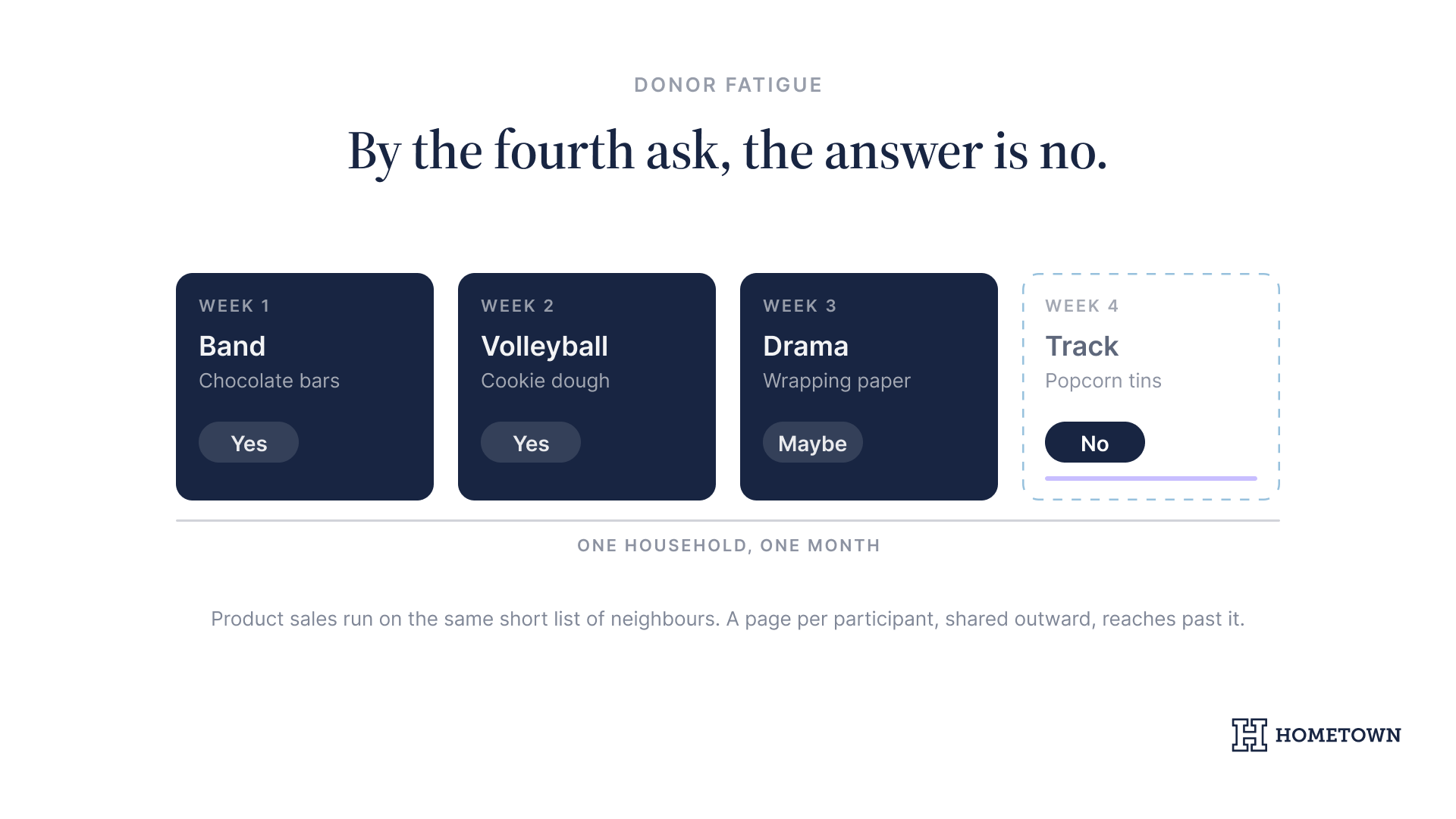
- Donor fatigue: the same local businesses and the same neighbors get asked by four teams in the same month, and by the fourth ask the answer is no.
- The share you never see: whatever the supplier keeps comes off the top, before a dollar reaches the program, so your students do the work twice over. What platform fees actually cost your program is worth reading with your own last campaign next to it.
- Cash that has to be counted: loose bills and paper checks are where the errors come from, and they are what makes audit season stressful. Digital financial tools exist because that problem is not unique to schools.
Moving to fee-free models
Schoolfundr, Hometown's fee-free fundraising platform, is built on a zero-fee fundraising model: no platform fee, no setup fee, no subscription, and no contract, kept that way by an optional tip your donors can decline at checkout. Schools keep 100% of the funds they raise, less any standard credit card processing fees, which is Stripe at 2.9% plus $0.30 per donation. In practice that is about 97% reaching reconditioned helmets, travel, or new uniforms, and navigating fundraising challenges is mostly about what happens to the other end of that number.
Fundraising spotlight
Langham Creek High School, Houston: raised more than $100,000 with Schoolfundr, keeping 100% of the funds raised, less any standard credit card processing fees. Broadneck High School soccer in Annapolis raised $24,000 the same way.
Why a district fundraising solution is a modern mandate
A district office has a different problem from a single coach: not one campaign, but thirty of them, each with its own spreadsheet. School fundraising software gives the business office one report shape from every school instead of one per building. For districts running drives at several campuses, Schoolfundr+ adds oversight across every school and program, at no cost to enroll. The same discipline pays off outside fundraising too, since automated grant screening now filters many applications before a human reads them, and clean records are what survive that filter.
How the money actually reaches your account
Ask this one early, because your treasurer will. With Schoolfundr, funds are held until your fundraiser has ended and you are ready to withdraw. At that point you can transfer them to a bank account or a debit card via Stripe, or Hometown can mail you a physical check. Stripe is the payment processor, and its fee of 2.9% plus $0.30 per transaction is the only deduction.
The questions to put to any provider
If your district has rules about who may hold funds, which processors are approved, and how money reaches a specific program account, put those in front of every provider before you sign, next to your questions about fees and contracts. Cash and check donations can be logged against the same goal, so the number on the campaign page is the real total and nobody is matching two sets of books at the end.
How modern platforms power extracurriculars
Sports and arts programs do not need different software, they need software that does not take a cut. Whether you are running a Hit-A-Thon or a straight donation drive, booster club fundraising software should make the setup short enough that a coach does it between practices. San Diego Unified raised $1.2 million with Schoolfundr in the last year, which is what this looks like at district scale.
1. Launch your page
Create a mobile-first donation page with your school branding, and tailor each fundraiser to your team's identity. Schoolfundr fundraising is designed so a coach can have a page live the same day the season starts.
2. Give every participant their own page
This is where the peer-to-peer part actually happens. Each student or parent gets a dedicated page and shares their own link with their own network, rather than the booster club broadcasting to one list and hoping. Sharing that page to Facebook or a group text is a separate action, taken when you want it, so put someone's name against it in your plan.
3. Track in real-time
Watch the total on your campaign page as it moves, with cash and check donations logged against the same goal. On a $20,000 campaign, roughly $19,400 reaches the athletes once Stripe takes its processing fee, and nothing else comes out.
Ready to get started?
Transitioning to a digital-first model ensures your program remains scalable and reliable. We recommend these next steps to modernize your funding this season:
- Pull your last vendor contract and find the share the supplier kept, in writing.
- Ask your business office which approvals a new payment setup needs, and how long they take.
- Run one team on an athletic fundraising platform this season and compare what the program actually keeps against last year.
Ready to see Hometown in action? Book a demo with our team.


.png)